
Search
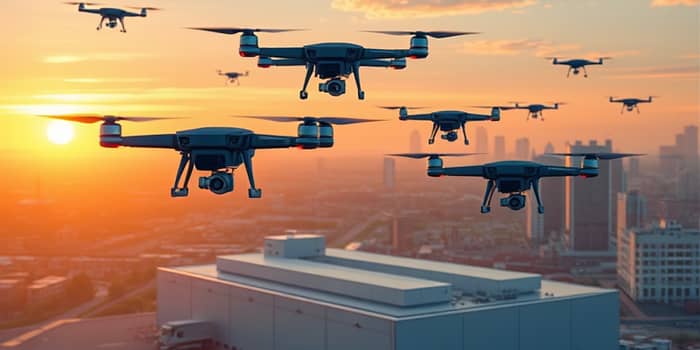
Imagine a world where the final mile in logistics is transformed into a seamless dance of efficiency and speed. In bustling warehouses and sprawling distribution centers, autonomous drones navigate complex aisles, scanning inventories and delivering packages with pinpoint accuracy. This is no distant dream, but an emerging reality reshaping how goods move from origin to destination.
The exponential growth of eCommerce has pushed supply chains to their limits, demanding faster deliveries, transparent tracking, and resilient networks. Autonomous drones—equipped with advanced sensors, AI-driven navigation, and real-time analytics—are stepping in to answer these challenges. By integrating indoor operations with outdoor last-mile delivery, they offer a unified approach to optimize every stage of the supply chain.
Drones have swiftly moved beyond novelty, carving out critical roles across logistics workflows. Their agility and autonomy enable businesses to address pain points that once seemed insurmountable.
Beyond these, drones partner with ground robots and autonomous vehicles, creating hybrid fleets that handle both heavy loads and nimble tasks. This synergy unlocks exponential optimization through swarm coordination and collaborative task sharing.
Introducing drones into logistics delivers measurable gains across efficiency, cost, accuracy, and sustainability. Organizations that embrace this technology position themselves for long-term competitive advantage and resilience.
The autonomous drone delivery sector is on a steep growth trajectory. As investments pour into intelligent automation, market value is projected to surge tenfold over the next decade. Strategic deployment of these systems promises substantial returns despite initial investments.
The power of autonomous drones lies in the seamless fusion of hardware and software. Advanced sensors—lidar, infrared, optical cameras—collect rich environmental data, while onboard AI algorithms perform real-time path planning and obstacle detection. Integrations with warehouse management systems (WMS) and enterprise resource planning (ERP) platforms ensure that drone operations align with broader business intelligence.
Key technological pillars include:
Leading logistics and retail giants are setting benchmarks by implementing drone fleets at scale. Amazon’s pilot programs achieve sub-30-minute deliveries, delighting customers with unprecedented speed. Walmart’s warehouses leverage RFID drones for nightly audits, boosting stock accuracy to nearly 100%. UPS uses drone routes to transport critical medical supplies to remote clinics, ensuring timely healthcare delivery.
Third-party logistics providers report dramatic operational shifts: one firm cut annual inventory hours from 4,400 to 800, redeploying staff to strategic roles. Another retailer eliminated stockouts by deploying barcode-scanning drones in large-format stores. These success stories illuminate how autonomous drones can become a strategic asset, not merely a technological novelty.
Despite the promise, challenges remain. Regulatory frameworks vary by region, limiting large-scale outdoor operations. Payload capacity is still modest, and adverse weather can disrupt flights. Upfront investments in hardware, software, and integration demand careful planning and stakeholder buy-in.
Looking ahead, industry leaders are collaborating with governments and technology partners to harmonize airspace regulations and develop robust drone corridors. Advances in battery chemistry and lightweight materials will extend range and payload. AI enhancements will bolster navigation in low-light and complex urban environments.
As eCommerce demands intensify and supply chains face unpredictable disruptions, autonomous drones will emerge as linchpins of agile, resilient logistics networks. By harnessing their potential today, businesses can build error-free, time-optimized operations that drive customer satisfaction, reduce costs, and foster sustainable growth.
The journey to fully autonomous supply chains is underway. Each flight brings us closer to a future where goods traverse skies with precision, and communities everywhere—urban and remote—enjoy reliable access to the products and services they need. This is the dawn of a new logistics era, powered by the silent hum of drones weaving through warehouses and across cityscapes.
References