
Search
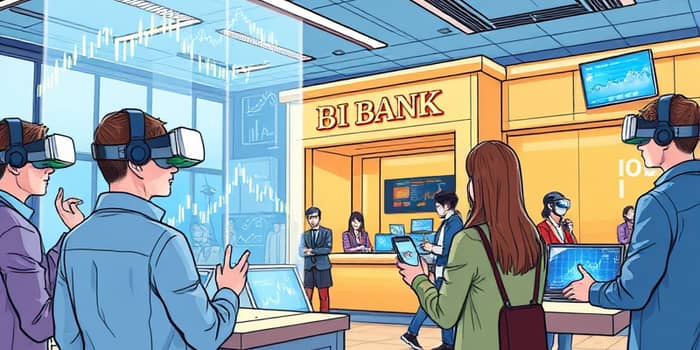
Immersive finance is redefining the way we interact with money, opening doors to fully three-dimensional worlds where banking and trading become sensory experiences rather than simple transactions. By harnessing the power of virtual reality (VR) and augmented reality (AR), institutions can deepen customer engagement, streamline internal workflows, and gain a competitive edge.
From virtual bank branches to holographic trading floors, these technologies are converging to create entirely new paradigms in financial services. This article explores the current landscape, practical benefits, tangible use cases, risks, and what lies ahead for immersive finance.
Immersive technologies encompass different modes of digital interaction. Understanding their distinctions is essential for crafting effective strategies.
While VR excels at creating fully immersive meeting rooms and simulation environments, AR is preferred for practical, real-world enhancements like ATM locators and spending visualizations. Institutions often adopt an XR approach to ensure flexibility across devices and use cases.
Financial institutions are deploying immersive solutions across retail and corporate banking to enhance customer journeys and optimize operational efficiency.
Imagine stepping into a bank branch from your living room using a VR headset. Italian online bank Widiba already offers this, allowing customers to walk through a digital lobby, meet advisors as avatars, and complete transactions in a secure virtual space.
Consulting firms like Accenture frame the metaverse as an opportunity to reintroduce deep emotional connection into digital banking. Users can personalize avatars, enter themed advisory lounges, and co-create financial plans in real time. These experiences span desktop, mobile, wearables, and VR headsets to ensure seamless transitions between channels.
On the go, AR transforms your smartphone into an interactive financial toolkit. Common AR features include:
BNP Paribas has piloted AR/VR virtual environments to offer real-time advisory, product walkthroughs, and remote support, yielding a noticeable uplift in customer satisfaction and retention.
Wealth clients can now explore their portfolios as tangible 3D objects. In VR, advisors and clients meet in digital boardrooms, manipulate holographic portfolio allocations, and simulate “what-if” economic scenarios. This approach fosters trust and clarity, leading to higher conversion rates for advisory products.
Key benefits include:
Banks and trading firms use AR/VR to train staff in compliance, customer service, and crisis response. Virtual meeting rooms enable distributed teams to analyze data, share virtual whiteboards, and simulate high-pressure scenarios without physical constraints.
These tools deliver a 5:1 ROI on training implementations and reduce onboarding times by up to 30%, according to pilot studies.
In trading environments, immersive technologies focus on rapid decision-making, error reduction, and enhanced team collaboration.
JPMorgan predicts that by 2026, 60% of institutional traders will use AR daily for complex analysis. For example, a global macro desk deployed holographic FX heatmaps and achieved a 53% faster opportunity identification rate and $4.2 million additional annual P&L.
Crypto market-making desks visualize order books as 3D structures, capturing 42% more arbitrage opportunities and reducing “fat finger” errors by 91%. Retail platforms like TradingView AR and eToro’s social AR bring immersive charting and collaborative trading to everyday investors.
Immersive environments allow institutions to navigate huge datasets as walkable landscapes. Heatmaps, network graphs, and volatility cones become tangible, making anomalies and opportunities more apparent. This immersive data visualization accelerates insight discovery, leading to more informed decisions and faster reaction times.
While the benefits are substantial, risks include data security vulnerabilities in virtual environments, user privacy concerns, and potential regulatory gaps around digital identity. Institutions must implement robust encryption, conduct regular audits, and collaborate with regulators to set clear standards.
Looking forward, advances in haptics, eye-tracking, and even neural interfaces promise deeper immersion. As 5G and edge computing mature, latency will drop, enabling more real-time collaboration and predictive analytics in VR/AR spaces.
By 2030, we may see fully integrated XR banking networks where customers switch effortlessly between AR mobile overlays, VR advisory lounges, and physical branches—with all channels synchronized in a single, personalized digital identity.
Immersive finance is not a distant fantasy. It is already here, reshaping the way we bank, trade, and interact with money. Institutions that embrace VR and AR today will be the pioneers of tomorrow’s financial ecosystems, delivering deeper connection, greater efficiency, and truly transformative experiences.
References