
Search
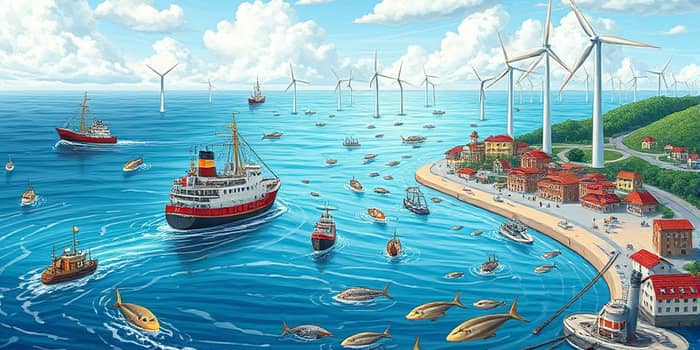
The ocean economy is at a crossroads, offering immense promise and pressing challenges. This article explores how strategic investments in the “blue frontier” can drive sustainable growth, create jobs, and safeguard marine ecosystems.
The term all economic activities linked to oceans encompasses traditional sectors like shipping and fisheries, as well as emerging fields such as offshore renewables and marine biotech. The EU defines the blue economy as including fisheries and aquaculture, coastal tourism, maritime transport, ports, and marine renewable energy.
A nature-positive, inclusive and sustainable model seeks to restore ecosystems while delivering growth and jobs. Experts estimate a net positive economic benefit of more than $15 trillion from a truly sustainable ocean economy, equivalent to roughly 15% of global GDP.
Ocean-based sectors accounted for roughly 7% of global trade in 2023, with a combined value exceeding $2.2 trillion in goods and services. Between 1995 and 2020, the ocean economy grew 2.5 times, outpacing the 1.9× growth of the broader global economy.
The private sector market was valued at about $1.96 trillion in 2024 and is projected to reach $3.78 trillion by 2034, reflecting a 6.8% CAGR from 2025 to 2034. Asia-Pacific leads regional share due to maritime trade and offshore energy investments, while Europe excels in marine energy and seafood exports.
About 600 million people rely directly on the ocean economy, which supports around 100 million jobs in fisheries, aquaculture, and tourism. The formal sector employs at least 133 million people globally, with informal work pushing true numbers even higher.
Over 3 billion people depend on the ocean for food security, and around 500 million are employed in small-scale fisheries. In 2022, the EU blue economy employed 4.82 million people—16% more than the previous year—and generated nearly €890 billion in turnover.
The ocean economy spans both traditional industries and emerging sustainable frontiers.
New sectors are reshaping the ocean economy towards low-carbon, regenerative models.
Despite its critical role in global trade, food, energy, and climate regulation, the ocean remains undercapitalized. Scaling up finance is imperative to unlock the ocean’s potential for sustainable growth.
Private markets anticipate robust expansion, with valuations rising from $1.96 trillion to $3.78 trillion over the next decade. Asia-Pacific and Europe are focal points, with significant capital flows into offshore wind, low-carbon shipping, and resilient port infrastructure.
The ocean economy faces multiple constraints, including climate-driven sea-level rise, extreme weather events, and maritime pollution. Aging port infrastructure and regulatory fragmentation further complicate investment.
Governance trends emphasize integrated approaches. The UN Decade of Ocean Science and regional frameworks like the EU Blue Deal foster collaboration. National strategies increasingly mandate marine spatial planning and climate adaptation measures.
Investing in the blue frontier demands a holistic vision that aligns economic interests with environmental stewardship. Multi-stakeholder partnerships across public, private, and civil sectors are vital to mobilize capital, share data, and scale innovative solutions.
By channeling resources into marine renewables, decarbonized shipping, and nature-based solutions, investors can generate sustainable returns while safeguarding ocean health. The transformative potential of the ocean economy hinges on collective action, robust policy frameworks, and a commitment to long-term environmental resilience and inclusive economic growth.
The tides are rising for the blue frontier. Stakeholders equipped with knowledge, capital, and a regenerative mindset can steer the ocean economy towards a future that balances prosperity with planetary well-being.
References