
Search
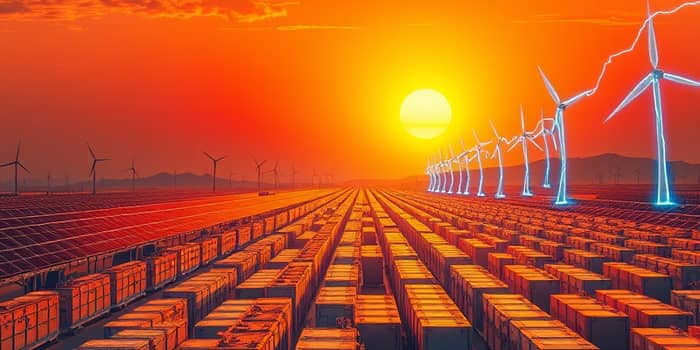
The global energy storage landscape is undergoing a profound transformation, driven by surging demand for reliable, low-carbon power solutions. Investors and policymakers alike are watching as capacity additions soar, new technologies emerge, and the race for cleaner grids accelerates.
In 2024, global energy storage installations leaped by over 75% year-over-year, surpassing all previous records by megawatt-hours. Projections indicate the industry will exceed the terawatt-hour mark before 2030, marking a pivotal shift in how the world balances supply and demand.
The US alone added 3.8 gigawatts in Q3 2024, amounting to roughly 11.9 GW annually, with expectations of more than 74 GW from 2024 to 2028. Meanwhile, China continues to dominate capacity growth through rapid wind and solar adoption paired with mandatory storage requirements. Europe reached a turning point as grid-scale storage surpassed distributed applications for the first time, and Latin America recorded a 42% deployment surge.
Cleantech spending, including storage, green hydrogen, and carbon capture, is set to reach $670 billion in 2025. Roughly one third of that will target distributed solar (<5 MW) and behind-the-meter storage. Overall energy investment across renewables, nuclear, grids, and storage will hit $2.2 trillion next year.
In Q3 2024, 83 financing transactions totaling $17.6 billion signaled growing maturity as debt and public financings outpaced venture capital. Investors are moving across the entire supply chain—from raw materials and module manufacturing to recycling and second-life applications.
Long-duration storage (over eight hours) installations are set to more than double the 2024 total, addressing the challenge of deep decarbonization and extreme weather resilience. Governments and grid operators worldwide are prioritizing these solutions to secure reliable baseload from renewables.
Innovations in solid-state batteries promise safer, higher energy density platforms, while new chemistries and LDES schemes attract both public and private support. Co-locating storage with data centers and critical infrastructure is emerging as a versatile use case that delivers backup power and grid services simultaneously.
In the United States, the Inflation Reduction Act provides ITC incentives and manufacturing credits, while 23 states plus DC and Puerto Rico have set 100% clean energy goals. Storage is increasingly recognized as a ‘non-wires alternative’ to traditional grid upgrades. However, uncertainty over tariff phase-outs and potential policy rollbacks could temporarily slow growth.
Europe and the UK are relaxing state aid rules for net-zero technologies, and the EU’s Critical Raw Materials Act enforces transparent battery material tracking by May 2025. Globally, supportive policies aimed at grid stability and climate targets continue to unlock capital, though geopolitical tensions and supply chain disruptions pose ongoing concerns.
The energy storage sector stands at the confluence of environmental urgency and technological opportunity. As markets mature and policy frameworks evolve, the window is wide open for investors, innovators, and policymakers to shape a cleaner, more reliable energy future. By understanding key drivers, navigating risks, and targeting high-potential segments, stakeholders can unlock significant value while driving the global transition to a sustainable electric economy.
References