
Search
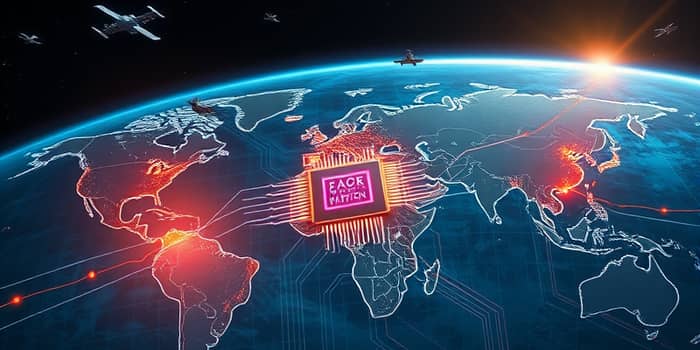
In the 21st century, control of semiconductors has become synonymous with global power. Nations and corporations are locked in a contest to dominate the supply chains, talent pools, and strategic chokepoints that govern the flow of these tiny yet vital components. As tensions rise, understanding this microchip battleground is crucial for policymakers, businesses, and citizens alike.
Microchips now function as the strategic weapons of the 21st century. From consumer electronics to advanced missiles, virtually every modern system relies on precise semiconductor technology. Their scarcity can cripple economies or tip military balances overnight.
These components are the enabler of AI and modern warfare. They power data centers, 5G networks, and precision-guided munitions. The U.S. Department of Defense alone allocates over $2 billion a year to microelectronics, growing by nearly 20% annually.
For China, chip imports rival its oil imports in strategic importance. A sudden disruption in Taiwan’s foundries, which supply about 90% of the world’s leading-edge nodes, would threaten both civilian infrastructure and national defense systems globally.
Decades of specialization created a fragile, hyper-globalized supply chain for semiconductors. Different regions carved out distinct niches, leading to unparalleled efficiency—and dangerous dependencies.
Key chokepoints emerged: Taiwan’s TSMC leads 2–5 nm fabrication, while ASML in the Netherlands is the only source of EUV lithography machines, each valued at over $200 million.
Since October 2022, the U.S. has pursued a weaponizable interdependence across global chokepoints to limit China’s access to frontier chips and manufacturing tools. Advanced AI accelerators like NVIDIA’s A100 and H100 series are now restricted, alongside critical EDA software and lithography systems.
Washington also targeted human capital, tightening visas for Chinese researchers in photonics, quantum, and semiconductor fields. Academic exchanges with Chinese institutions are increasingly viewed through a security lens, broadening the conflict beyond trade.
These measures aim to delay China’s ability to field next-generation weapons and supercomputers, preserving U.S. and allied commanding lead at the technological frontier.
In reaction to U.S. controls, Beijing launched an ambitious drive for tech sovereignty and chip empire building. Under “Made in China 2025,” the government has funneled tens of billions into domestic foundries, memory producers, and equipment makers like SMIC and YMTC.
Despite bans on EUV exports, SMIC has achieved 7 nm production using Deep Ultraviolet (DUV) hardware—a testament to Chinese ingenuity. Huawei’s in-house 5G chips and the Ascend AI series further illustrate rapid progress.
Rather than chasing only the bleeding edge, China is focusing on mature nodes (28 nm, 40 nm) that power cars, industrial machines, and IoT devices. Forecasts suggest the country will add more chip capacity in these segments over the next five years than the rest of the world combined.
The semiconductor conflict has spawned a “technological iron curtain.” The U.S.-led bloc prioritizes onshoring, friend-shoring, and massive subsidies to secure a trusted supply network among allies like Japan, South Korea, and Europe.
Meanwhile, the China-anchored bloc doubles down on self-sufficiency in mature-node mass production and nurtures alternative ecosystems around open standards like RISC-V. Beijing has even restricted exports of critical minerals like gallium and germanium to pressure Western chipmakers.
For global companies, this bifurcation means juggling dual strategies: advancing cutting-edge research while maintaining compliance and operational resilience in two divergent markets.
Policymakers must strike a balance between security and collaboration. Too much decoupling raises costs and stifles innovation, while too little risks strategic vulnerability.
Businesses should map their exposure to each bloc, adjust procurement and R&D investments accordingly, and pursue strategic stockpiling of critical components and materials.
Individuals can contribute by pursuing careers in semiconductor engineering, policy analysis, or supply chain management. Public awareness of these microchip dynamics empowers citizens to advocate for resilient infrastructure and informed national strategies.
In this high-stakes contest, tiny microchips carry enormous weight. By understanding the geopolitical currents and adopting proactive measures, governments, companies, and individuals can help ensure a future where technological progress remains both secure and inclusive.
References