Search
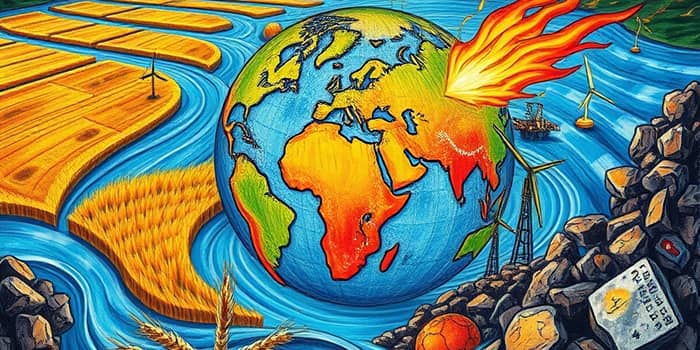
In a rapidly shifting world, the battle for energy, food, water and metals has become intensifying global competition for resources. Population growth, climate change and geopolitical tensions are converging to create unprecedented strains on supply chains. As we approach 2025 and beyond, understanding these dynamics is vital to charting a sustainable and equitable path forward.
This article examines the historical roots of today’s scramble, sector-specific challenges, and the policies, innovations, and collaborations that can transform scarcity into resilience. By highlighting data-driven insights and inspiring examples, we aim to equip stakeholders with innovative financial and policy responses.
The post–World War II era ushered in sustained economic expansion, powered by abundant oil, rising agricultural productivity and expanding trade. Yet the global south’s development has come at the cost of overexploiting finite resources. A multipolar world now redistributes economic power, driving competition for raw materials and energy.
As major producers in China, India and Latin America mature and growth slows, new frontiers of resource nationalism emerge. The underlying lesson is clear: without inclusive governance and sustainable practices, prosperity can fuel conflict as easily as it can promote stability.
Water scarcity stands at the heart of the scramble, affecting agriculture, industry and households alike. By 2025, 600 million people across 21 countries will face extreme scarcity, rising to 1.4 billion in 36 countries soon after. Nearly two-thirds of humanity will be at risk without immediate action.
Compounding the water crisis are climate-driven disruptions to agricultural yields. Crop failures in Sub-Saharan Africa and South Asia threaten food security for hundreds of millions, fueling migration and social unrest.
To address this, policymakers and farmers must invest in efficient irrigation, drought-resistant seeds and integrated water management systems. International partnerships can pool resources and knowledge, turning localized triumphs into global best practices.
The shift from oil to natural gas, coal, biofuels and renewables unfolds against a backdrop of volatile production and geopolitics. Non-OPEC oil output growth is slowing, while LNG exports rise in the Americas and Middle East. Yet OPEC remains a powerful supply lever.
Prices are forecast to slide by nearly 12% in 2025, with a modest 5% drop in 2026. Market forecasts warn of a -26% downside scenario if trade tensions escalate or OPEC+ policies tighten.
Amid these fluctuations, investments in renewables are surging. Solar capacity has expanded by 160% in five years, offering a hedge against hydrocarbon shocks and diversification into renewable and circular systems.
Electrification, data centers and electric vehicles are driving record demand for copper, nickel, aluminum and lithium. Prices may dip by 10% in 2025, but upside risks loom if supply chains falter or geopolitical disputes intensify.
To secure critical minerals, nations are forging partnerships in Latin America, Africa and Asia. Prepayment mechanisms and trade finance innovations provide capital for new mines, even as environmental and social safeguards become non-negotiable.
Global food demand is projected to rise by 50% by 2030, propelled by population growth and shifting dietary preferences. Yet extreme weather events disrupt harvests, sending shockwaves through global markets for grains, cocoa and coffee.
The World Bank warns that climate losses will concentrate in vulnerable regions, exacerbating inequality and poverty. Addressing this requires both short-term risk management—crop insurance, price hedging—and long-term investments in agroecology and soil health.
Commodity prices overall could reach a six-year low in 2025, but historical drawdowns have spiked by up to 25% during negative growth quarters. Upside scenarios, however, include weather shocks or escalated resource nationalism.
Experts advocate for a blend of monetary, fiscal and trade policies: strategic reserves, tariff adjustments and digital platforms for transparent pricing. Unprecedented growth in commodity demand calls for equally bold governance frameworks.
Today, 75% of all resource extraction is non-renewable, yet global extraction could surge by 150% by 2060. Transitioning to a circular economy—where waste becomes input—offers a compelling alternative.
Innovations in recycling, remanufacturing and product design can decouple growth from raw material consumption. Companies and governments piloting these models report both environmental and economic gains, underscoring the viability of a regenerative future.
As we approach 2025, the interplay of climate change, demographic shifts and great power dynamics will define commodity markets. Potential new era of resource nationalism raises the stakes for cooperation and innovation.
Humanity stands at a crossroads: we can deepen divides through competition and hoarding, or we can forge alliances that ensure equitable access to the essentials of life. By embracing sustainable practices, deploying cutting-edge technologies and fostering transparent governance, we can transform the scramble for resources into a catalyst for shared prosperity.
The challenge is immense, but so too is our capacity to innovate and collaborate. The choices we make today will reverberate for generations, shaping a world where resource abundance is not an illusion but a collective achievement.
References